

Frequently Asked Questions
For Intermediate and Advanced Riding Clinics
Am I ready for the Advanced Riding Clinic?
Because of the advanced cornering skills and techniques that we teach during ARC, it is important that riders who take this course arrive with a solid riding foundation in order to make the most out of the class. The best way to assess if you are ready for ARC is by responding to these other three important questions:
- Do you feel confident and relaxed riding through a curvy road, at regular road speeds?
- Do you feel confident in your ability to swerve around an unexpected obstacle, at road speeds?
- Do you feel confident in your ability to make your motorcycle stop in a very short distance during an emergency?
If you answered YES to the three questions above, then ARC is for you and you will enjoy it greatly! However, if you responded NO to any of the questions above, you should consider the Total Control Intermediate Riding ClinicSM as the next step in your riding education.
Do I need a motorcycle license to take the Intermediate/Advanced Riding Clinics?
Yes. These classes are for riders that already have a current drivers license with a motorcycle endorsement. Total Control classes do not teach beginning riders how to operate or ride a motorcycle. The course does not prepare students for taking any driving tests for the purposes of obtaining a motorcycle license, nor does it provide a waiver from taking any state motorcycle riding tests.
Do I have to bring my own motorcycle to the class?
Yes. Students must provide their own motorcycles for the class. Motorcycles used for the range exercises must be street-legal and have current registration. In addition, students must have a motorcycle insurance policy in force. Students must provide insurance policy and license (tag) numbers at the start of the class.
What kind of motorcycle do I need for the class?
Virtually any street legal motorcycle can do the class. We have taught students on a wide variety of bikes ranging in size from 250cc to 2,000ccs or more.

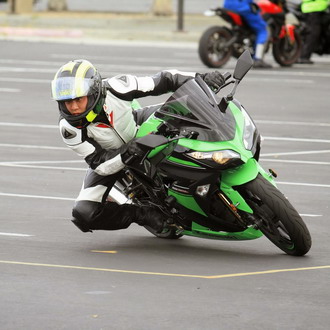
I ride a sportbike, what am I going to get out of riding in a parking lot?
More than you'd imagine. The range exercises provide a laboratory where you can examine your technique under a microscope. You can improve your cornering technique in a reduced-risk, controlled environment with instant instructor feedback. While the class is focused on street riding, many of our students also participate in track days. In addition, road racers have taken the class to improve their cornering skills and lower their lap times.
Is Total Control a race or a racing school?
No. The class is targeted for street riders of all types of motorcycles. Only one motorcycle is allowed on the range at the same time, there is no timekeeping, and it is not a competition. However, if you are interested in competition, this is an ideal course to prepare you for participating in a track day.
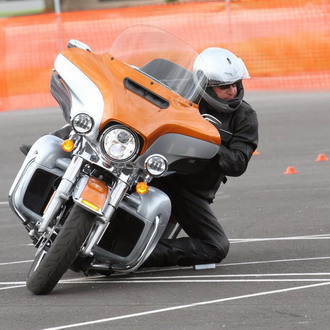
I ride a heavy cruiser, Gold Wing or full touring rig with floor boards. What can I get out of the class?
The opportunity to expand your limits. Many touring riders fear dragging hard parts or do drag parts in higher speed turns. Our curriculum will show you how to use body position to avoid, or minimize touching down when going through a turn. This will allow you to either travel faster through a given radius turn, or more importantly allow you to turn tighter in an emergency situation.
What type of riding gear do I need to take a Total Control class?
Protective riding gear is required during the range exercises. Protective gear includes; a riding jacket (or mesh jacket), riding pants (leather chaps or mesh pants are OK), gloves, boots that cover the ankle and a DOT-approved helmet (full faced helmet is recommended but not required). Jeans and fingerless gloves are not allowed, but Kevlar jeans will be accepted.
Do I need to do anything to my motorcycle prior to taking a Total Control class?
Your motorcycle should be well maintained. This includes the following:
- Your tires should have sufficient tread (at least 3mm). Air pressure will be checked before the class starts.
- No car tires or race tires or race compound tires allowed regardless if they are DOT approved. Your bike should not overheat while stopped with the motor running on a hot day.
- On liquid cooled bikes, check the coolant level.
- Check the engine oil level.
- Your charging system must function properly, and a relatively new battery is highly recommended because you will be starting the bike frequently.
- Make sure your brakes are in good working order.
- No motorcycles with leaking fluids will be allowed on the range. This includes: engine oil, transmission fluid, gasoline, engine coolant, brake fluid or anything else that may leak from a motorcycle.
- Absolutely no race tires or race compound tires are allowed even if they are DOT-approved. These tires will not get hot enough to maintain traction during the class.
My motorcycle has an aftermarket exhaust system. Is that a problem?
Some Total Control locations are sensitive to loud exhaust noise. If you are using the factory installed stock exhaust system, exhaust noise will not be an issue. If you have an aftermarket exhaust and you want to know how loud is too loud, call the training site where you want to sign up for more information.
How much of the Total Control, Level 1 class is in the classroom vs. on the range?
The TCARC is 40% classroom and 60% range exercises. The classroom sessions are spread throughout the day. This gives riders a chance to rest, a necessity when the weather is hot.
How is the Total Control, Level 1 class taught?
Total Control, Level 1 consists of six modules. These exercises include; throttle/brake transitions, mental state, corner vision, corner entry and line selection, mid-corner body position & corner exits, corner transitions (figure 8's) and basic motorcycle suspension. There is a 10-minute break between each module and a 40-60-minute break.
What are the Total Control, Level 1 range exercises like?
Level 1 range exercises are practiced on 40-foot circles. Two pairs of 40-foot circles (marked using small rubber traffic cones) accommodate six students each. New skills introduced for each exercise builds on the previous exercise. The first couple of range exercises are deceptively simple and form the basis for the more challenging exercise later in the day.
How long is the class and what about lunch?
Total Control classes are eight-hours in length with an hour for lunch. Class starts at 8:00am and finishes around 6:00pm. A 40-60 minute lunch break takes place about noon. Please bring your own lunch and a snack if you like. Bottled water will be provided at some sites. (Please contact the Total Control site where you will be taking the class for more details)
How many students are in a Total Control class?
Total Control, Level 1 and 2 classes can have 6 to 36 students depending on where you take the class. The instructor to student ratio is one instructor for each group of six students. Only one student at one time is allowed on the range and is always supervised by an instructor.
What happens if it rains?
Total Control classes will be held in light rain. If several days prior to the class the weather looks questionable the class may be canceled. Individual Total Control training sites will vary in their policies regarding weather related class cancellations, rescheduling or refunds. Please contact the training site where you are taking the class for details.
What about Total Control training site liability insurance?
All of the Total Control locations have liability insurance by the top carrier in the nation for training sites. This insurance coverage is only for liability risks while you are participating in a Total Control class. You must have your own insurance policy for the motorcycle you are riding. Please have the policy number and name of your insurance company with you when you arrive at class.
What qualification do the Total Control instructors have?
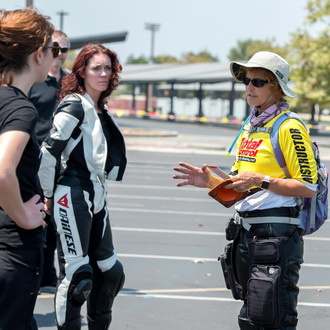
All Total Control instructors have received intensive training. In addition to the formal training, instructors are supervised by a certified master instructor until they are comfortable with teaching the class by themselves. Instructors must have at least five years of riding experience. Refresher courses are given on an annual basis.


Do Students get a certificate after taking a Total Control class?
Yes. Each student will receive a certificate with their name on it after taking the class.
When are the Total Control classes held?
It depends on the site and their location. The schedule is located here. Most Total Control sites hold classes from April through September, but sites in warmer climates may have winter classes as well.
Can I bring my spouse/significant other as passenger?
Yes, provided you and your passenger have already established comfort and trust. We have taught rider/pillion couples, and all the lessons apply equally to one-up or two-up riding. There may be a charge for the passenger, depending on location. Call the site location for more details.
I loved the Total Control, Level 1 class. Is there a Level 2 class?
Yes. Total Control, Level 2 are available at selected locations (see schedule). As more Total Control instructors become trained to teach Level 2, more classes will be available. Total Control Advanced Riding Clinic, Level 2 starts where the Level 1 class left off. Included are more challenging exercises from the best-selling book Total Control plus some exciting new ones that will allow students to take their riding to a whole new level. Hard braking, trail braking, speed shifting (both up and down), decreasing radius turns, bike setup and more will be featured in this follow-up to the most effective advanced riding curriculum on the market. Read more about our ARC Level 2 here.
 |
 |
 |
 |
 |
 |
 |
 |
 |
 |
 |
 |
 |
 |
 |